Origin concentration is a supply risk metric
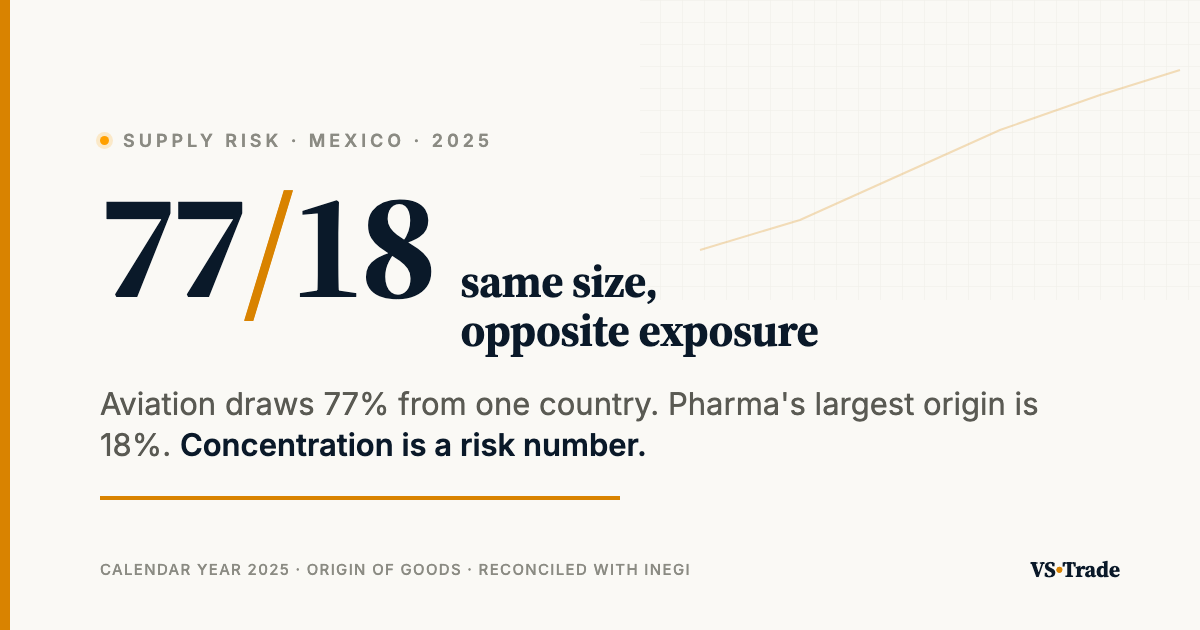
Two sectors can import similar amounts into Mexico and carry completely different exposure. The difference is not in the volume. It is in how many countries that volume comes from.
By VS-Trade Research · Structural analysis
Two sectors, similar size, opposite structure
Aviation and pharmaceuticals imported comparable value into Mexico in 2025 — $10.70B and $10.42B respectively. On a volume ranking they sit next to each other. Structurally they have nothing in common:
Aviation. United States 77%, France 9.4%, Canada 6.5%. Three origins cover more than nine tenths of the sector.
Pharmaceuticals. United States 18%, Germany 13%, Italy 8.4%, Ireland 7.9%. The largest single origin does not reach one fifth.
Calendar year 2025. Origin of goods, definitive plus temporary import universe, rankings base.
One sector depends on a single country for three quarters of its supply. The other spreads across a dozen without any of them dominating.
What concentration does to risk
A disruption is not an abstract event: it happens in a place. Tariff changes, regulatory shifts, port stoppages, currency moves, export controls — all of them are geographic.
That makes origin concentration a measurable proxy for how exposed a category is:
- A sector at 77% single-origin transmits nearly the full impact of a shock in that country. There is no meaningful buffer.
- A sector where the largest origin is 18% absorbs the same shock with a fraction of the effect, because substitutes already exist in the flow.
Neither structure is inherently better. Concentration usually reflects genuine reasons — certification requirements, regional agreements, physical proximity, technical dependency. But it should be a known quantity, not a surprise discovered when something breaks.
The case that gets missed
Rail logistics equipment imported $0.81B in 2025 — small enough that it rarely appears in sector analysis. Its origin structure: United States 71%, China 18.6%.
Two countries, nearly ninety percent. In a category that supports the physical movement of everything else. Small sectors are frequently the most concentrated ones, and their disruptions propagate into much larger sectors that depend on them.
Volume rankings systematically hide this, because they sort by size and concentration has nothing to do with size.
The question to ask about your own category
Not "where does it come from?" — that is usually known. The useful questions are:
How much of it comes from the largest origin? Above roughly two thirds, you are effectively single-sourced at a national level.
How many origins cover 90%? If the answer is two or three, your substitution options in a crisis are theoretical rather than actual.
Is concentration rising or falling? The direction matters more than the level. A category concentrating year over year is accumulating exposure quietly.
How this is measured
Origin here means origin of the goods — where they were produced — not the country of the invoicing company. Those are different fields and they frequently disagree. A supply risk analysis built on invoicing tells you where the intermediary sits, not where your exposure is.
The universe reconciles with the merchandise trade balance published by INEGI for 2025 within 3.6%, a structural differential explained by the valuation basis and the treatment of virtual operations.
VS-Trade Intelligence compiles from legally obtained sources, including licensed third-party data providers, public records and proprietary analytical research. We do not redistribute raw datasets.
In one line
Volume tells you how big a category is. Origin concentration tells you how much of it can stop at once.
Want the origin structure of your category? Concentration, direction of change and substitution options. Request a complimentary brief at vstrade.co.