Who actually buys what you ship to Mexico
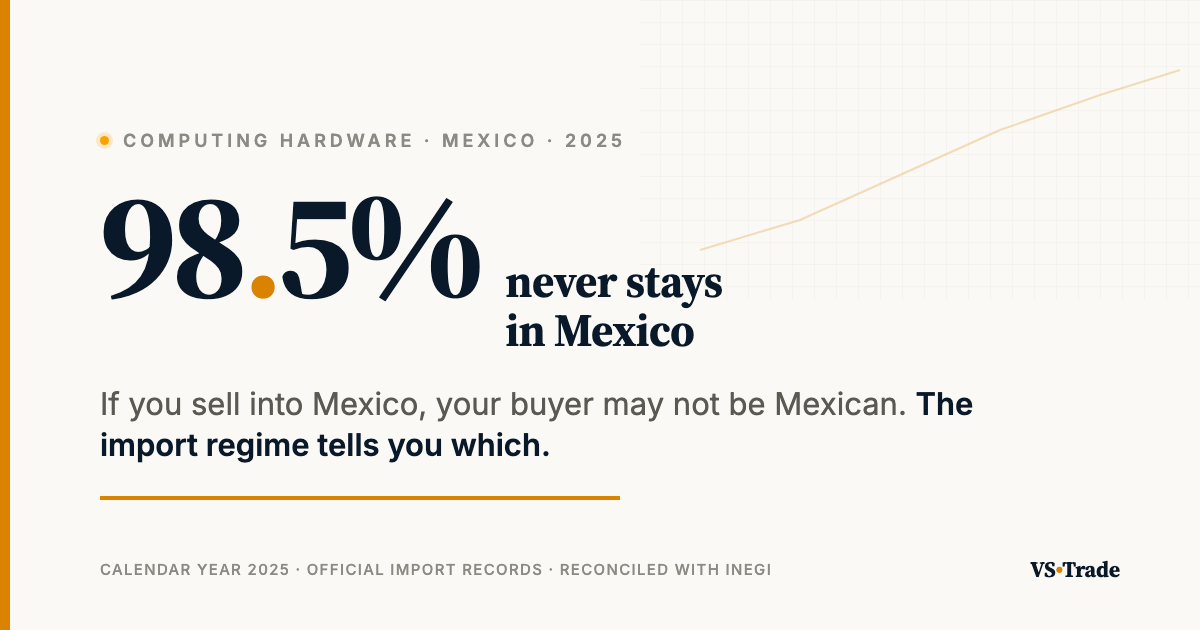
If you sell into Mexico, there is a reasonable chance your buyer is not Mexican. Not in the sense that matters commercially. The company receiving your goods may sit in Mexico while the decision to buy them was made somewhere else entirely — and the customs record tells you which of the two situations you are in.
By VS-Trade Research · Structural analysis
Two ways in, two different customers
Every shipment entering Mexico is declared under a regime. Two of them account for nearly all industrial trade.
Definitive import. The goods enter and stay. They are sold, consumed or installed in the Mexican market. Your customer is the Mexican market.
Temporary import under a manufacturing programme (IMMEX). The goods enter to be transformed or assembled and then leave again. Mexico is a production platform, not the destination. Your customer is whoever owns that platform — usually a headquarters in another country.
Both show up in the same import statistics. Both are routinely described as "nearshoring". For a supplier they are completely different accounts, with different decision makers, different pricing logic and different renewal cycles.
The automotive split
The clearest illustration sits inside a single industry:
| Line | 2025 | Under IMMEX |
|---|---|---|
| Auto parts (8708) | $17.03B | 71.5% |
| Finished vehicles (8703) | $15.22B | 0.0% |
Calendar year 2025. Definitive plus temporary import universe, rankings base.
Auto parts arrive overwhelmingly under the temporary regime: they come in to be assembled and leave as vehicles bound for other markets. Finished vehicles arrive under the definitive regime, almost entirely: they come in to be sold locally.
Same industry. Opposite behaviour. If you supply parts, your commercial counterpart is a multinational's sourcing function. If you supply vehicles, it is a Mexican distribution network.
The full spectrum
Across the sectors measured, the dispersion is total:
| Sector (2025) | Under IMMEX |
|---|---|
| Computing hardware | 98.5% |
| Aviation | 91.7% |
| Rail logistics (8607) | 89.0% |
| Auto parts (8708) | 71.5% |
| Pharmaceuticals (ch. 30) | 6.8% |
| Finished vehicles (8703) | 0.0% |
Calendar year 2025. Share of the temporary manufacturing regime over each sector's definitive plus temporary total, rankings base.
At one end, computing hardware: 98.5% temporary. Almost nothing that enters stays. At the other, pharmaceuticals: 6.8%. Almost everything stays, because it answers domestic consumption.
What this changes for a supplier
Who you are actually selling to. If 98.5% of your category enters under the temporary regime, a commercial strategy aimed at the Mexican market is aimed at the remaining 1.5%. The budget lives with the parent company that decided to put a plant there.
How to read your own growth. A category growing through the temporary regime is gaining installed capacity, not local customers. The number rises either way, but it does not signal a market opening up to you.
Where your risk sits. Domestic demand and export platforms do not move on the same cycle. A temporary-regime category is exposed to decisions taken in the supply chain that feeds it from abroad; a definitive-regime category is exposed to Mexican consumption.
How this is measured
The regime is not inferred — it is declared on every import operation, which makes the two universes separable rather than estimated.
The figures above cover calendar year 2025 and come from the definitive plus temporary import universe, excluding virtual transfers and rectifications, which would otherwise double count. That universe reconciles with the merchandise trade balance published by INEGI for 2025 within 3.6% — a structural differential explained by the valuation basis (FOB in official statistics, customs value in the operational record) and by the treatment of virtual operations.
VS-Trade Intelligence compiles from legally obtained sources, including licensed third-party data providers, public records and proprietary analytical research. We do not redistribute raw datasets.
In one line
Before asking how big the Mexican market is for your product, it is worth asking how much of it stays in Mexico at all. The answer changes who you should be calling.
If you ship to Mexico, request the read on your own category — how much of it stays, how much only passes through, and how that changed over the last year. Complimentary brief at vstrade.co.