French wine in Mexico, the Dominican Republic, Colombia and Ecuador: 2025 and 2026 figures
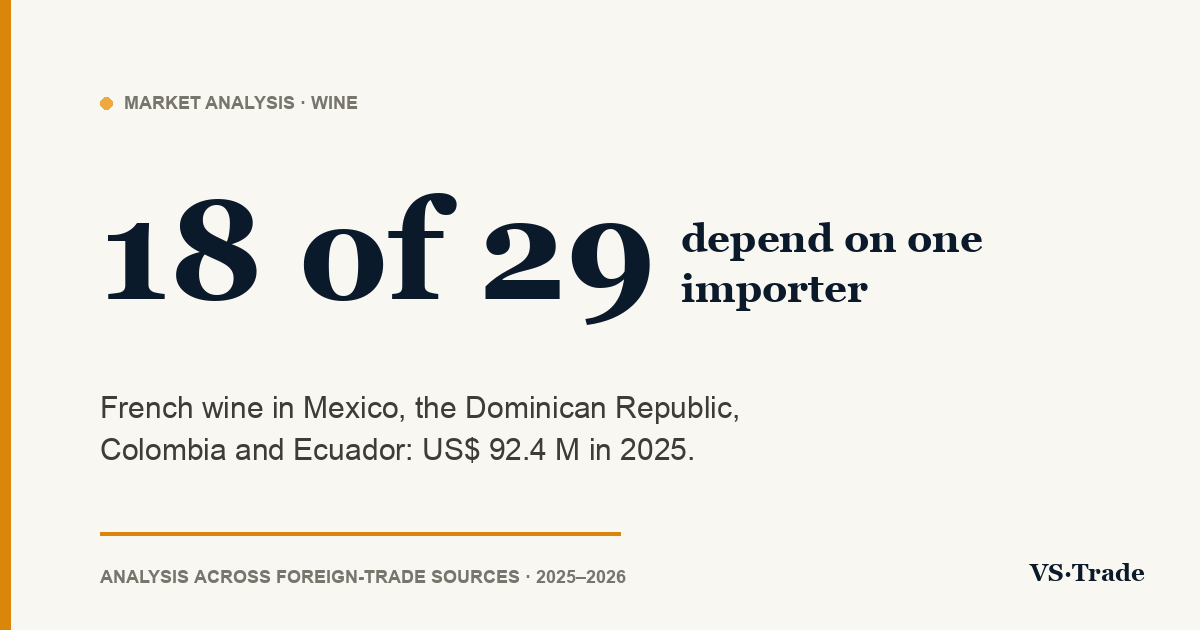
Mexico, the Dominican Republic, Colombia and Ecuador bought US$ 92.4 M of French wine in 2025. So far in 2026, Colombia is up 13.9% and the Dominican Republic is up 2.5%.
By VS-Trade Research · Market analysis
Four markets, four sizes
According to our analysis, which cross-checks several foreign-trade sources in each country:
| Country | 2025 value | Importers | French wine houses | 2026 vs. same months of 2025 | Average price per litre since January 2025 | Largest importer's share |
|---|---|---|---|---|---|---|
| Mexico | US$ 67.6 M | 84 | 87 | +13.7% (January–August) | US$ 18.53 | 53.5% |
| Dominican Republic | US$ 13.7 M | 33 | 64 | +2.5% (January–August) | US$ 8.77 | 26.2% |
| Colombia | US$ 8.3 M | 27 | 58 | +13.9% (January–July) | US$ 5.70 | 57.8% |
| Ecuador | US$ 2.9 M | 10 | 9 | +6.2% (January–July) | US$ 6.60 | 43.7% |
Mexico is the largest of the four markets for French wine.
18 of 29 positions depend on a single importer
We measured every case where one of the French wine houses sold more than US$ 200,000 in one of these countries in 2025. In 18 of 29 (62%), 90% or more of the value came in through a single importer. By country: Mexico 10 of 18, Dominican Republic 5 of 7, Colombia 2 of 3, Ecuador 1 of 1.
Having one importer carry the brand in a country is not a problem in itself. The problem is not seeing what that importer does with the rest of its portfolio: which other wineries it buys from, at what price, and whether its volume drops because it sells less or because it buys from someone else.
How we measure it
Values are declared invoice values at import, at each shipment's incoterm. Each importer and each winery is grouped by its tax ID or, when there is none, by its normalised name. Changes compare the same months of 2025 and 2026. Whatever comes in through a consolidator without naming the winery is not attributed to any. Details in our methodology.